From Parlor Pastime to Pocket Puzzle
A pocket puzzle turns spare moments into satisfying leisure. Choose a fitting challenge, make room for it in your routine, and keep it ready to carry.
The common mistake with a pocket puzzle is choosing one that demands a clear table and a long, quiet stretch. Then it stays at home, and the little gaps it was meant to fill become gaps without a puzzle. A better approach is to shape the activity around the places you actually pause.
The shift from parlor pastime to pocket puzzle is less about a particular puzzle than a change in setting. Leisure once arranged around a room, a chair, and an uninterrupted visit can travel with a person. To make that shift work for you, start with your pauses, choose a challenge that suits them, and give the puzzle a simple way to come along.
Start with the pauses already in your day
Before choosing anything, notice where you naturally have a little attention to spare. Perhaps you wait for a kettle, sit before an appointment, or take a quiet break between errands. These moments differ: some are calm and settled; others can end abruptly.
Pick one likely setting and describe it plainly. Are your hands free? Can you set a small item down? Will you need to stop without warning? A puzzle for a station bench should be easy to put away, while one for a favorite armchair can tolerate a more deliberate setup.
This is a small but useful change in thinking. Instead of trying to squeeze leisure into every spare minute, you give one familiar pause a pleasant option. If the pause disappears, the puzzle can wait.
Choose a challenge that fits the setting
Now decide what kind of attention you want the puzzle to invite. A compact paper logic puzzle suits someone who likes to think through a clue without moving pieces. A small mechanical puzzle offers a tactile challenge, but may need both hands and somewhere safe to rest it. A word puzzle can be easy to resume if its page or card marks your place.
Consider the friction around the puzzle as well as the puzzle itself:
- Setup: Can you begin without arranging several pieces?
- Interruption: Can you stop and remember where you were?
- Handling: Does it work comfortably in the place you have in mind?
- Storage: Can its loose parts stay together?
- Mood: Does it feel inviting when you are tired, or does it ask for more focus than you want to give?
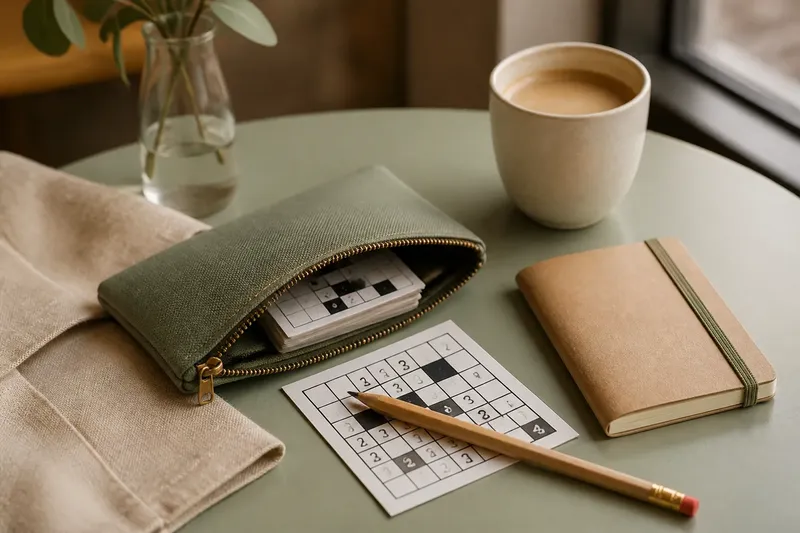
Say you usually have a quiet wait in a café but dislike spreading things across a table. You might choose a single puzzle card and a pencil, then tuck both into a slim envelope. The expected result is a challenge you can begin at your seat and put away together when your drink arrives or you need to leave.
Make a small kit that travels neatly
Once you know the setting and format, gather only what the puzzle needs. A reused envelope can hold a few printed or handwritten puzzle cards. A pocket notebook can keep a word puzzle and its working notes in one place. A pencil with an attached eraser avoids carrying extra supplies. For a puzzle with pieces, a fabric pouch or small tin helps keep them from escaping.
Check that the container opens easily and closes securely. It should fit the puzzle without crushing corners, bending pieces, or forcing you to repack it carefully each time. If you already carry a bag, choose a spot where the kit is easy to reach rather than buried beneath everything else.
Keep the kit modest. Extra pens, spare puzzles, a decorative case, and elaborate labels are not worth the effort if they make the activity cumbersome. The useful question is whether you can take out the puzzle, enjoy it, and put it away with little fuss.
Build a repeatable pause without making a rule
Try pairing the puzzle with one pause you already encounter. It might come out while you wait for a friend, or during a quiet stretch before heading home. A familiar cue makes it easier to remember, but the puzzle should remain an invitation, not another task to complete.
Leave some room for changing circumstances. A crowded bus may not be a comfortable place for loose pieces; a brief wait may be too short for a puzzle with a complicated setup. On those days, skip it or use a simpler card. The point is to make leisure available, not to turn every idle moment into an assignment.
When you stop, mark your place if the puzzle allows it. Fold a corner of a scrap paper as a page marker, jot a brief note in the notebook, or return all pieces to the pouch. That tiny closing habit makes it easier to pick up the thread later without rebuilding the whole scene.
How do you keep a pocket puzzle enjoyable?
What makes a puzzle portable?
Portability depends on more than size: setup, loose pieces, and the ease of stopping all matter. Choose a format that suits the places you visit and the way you handle your belongings.
Should you bring one puzzle or several?
Begin with one that you genuinely want to solve. A small choice can feel easier to reach for than a crowded bundle, and you can add another later if you notice a clear reason.
What if you keep forgetting to take it along?
Place the kit beside an item you already pick up, such as your keys or notebook, or keep it in a familiar pocket of your bag. If it still gets left behind, reconsider whether that location is part of your normal routine.
What if the puzzle feels like work?
Set it aside without treating the unfinished challenge as a failure. Try a gentler format or reserve it for a calmer pause; enjoyment is a better guide than completion.
Let the puzzle change with your routine
After you have carried the kit for a while, notice what happens in practice. Perhaps you reach for a pencil puzzle at home but prefer a tactile one when seated somewhere quiet. Or the pocket notebook may serve you better than loose cards because you can keep your place between outings.
Adjust one thing at a time: replace the format, move the kit, or choose a different pause. There is no need to build a collection of portable challenges before you know what you enjoy carrying. The pocket puzzle works best when its small footprint leaves room for the moment around it: a quiet bench, a waiting room, or a few unhurried minutes at home.
For a pocket puzzle, the most useful measure is not how many you finish, but whether the activity fits naturally into a pause you already have. Keep the one that makes that pause feel more like your own, and let the rest stay on the shelf.